
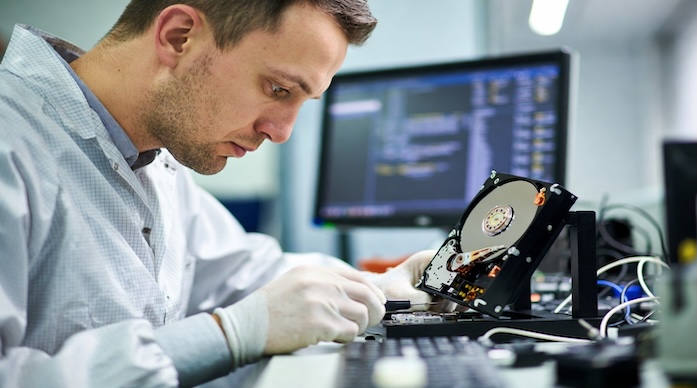
Recovering files and repairing the device for further use are different outcomes to request. Data recovery services in Glasgow should assess the storage medium and required data before explaining a recovery attempt. These five confirmed services cover Glasgow, with local hand-in, collection or wider laboratory arrangements. Their order is not a ranking, and a Glasgow contact page does not establish that all work happens in a city laboratory. Ask where diagnosis and recovery take place.
Say an external drive holds family photos while another device contains business accounts needed urgently. Identify the priority files instead of asking only whether the hardware can be fixed. General reading through Technical Bridges Systems is not a diagnosis. Tell the recovery provider what occurred and what has already been attempted, without assuming every inaccessible device has the same fault or recovery prospects.
1. Data Clinic
Data Clinic lists a Glasgow office at Tay House on Bath Street, operating by appointment. Its page explicitly says recovery takes place in its specialist UK laboratory rather than at the local hand-in point. It identifies hard drives, SSDs, phones, RAID and removable storage. Consider an enquiry where that logistics arrangement suits you. Ask about the assessment, transport and return of recovered files. A local reception address and the recovery laboratory should not be treated as the same facility when comparing services.
2. Glasgow Data Recovery
Glasgow Data Recovery publishes local services for drives, SSDs, RAID and lost files, describing in-house work and an assessment followed by a fixed quotation. Its payment terms are qualified by the job, so confirm the written arrangement directly. Enquire if the stated storage type matches your device. Ask what counts as a successful recovery. Recovering some files and recovering the particular documents you need are not necessarily identical outcomes, and the quotation should explain how that difference affects authorization and payment.
The storage description matters more than a guess based on the computer’s symptoms. A resource such as Technical Nodes Network cannot establish the failure. Give the provider the device model, observed behaviour and relevant incident history. Think of the enquiry as a handover record: information about drops, liquid, deletion or previous work helps define what needs assessment rather than become an invitation to promise a complete result before examination.
3. Secure Data Recovery
Secure Data Recovery expressly publishes Glasgow services for hard drives, smartphones and memory cards, with wider UK coverage. This confirms a Glasgow enquiry route, not a verified city laboratory for every case. Ask where the device is assessed and which team accepts the storage type. If sensitive business information is involved, discuss handling and return arrangements before sending media. A broad recovery service description should not be assumed to explain access, retention or how the recovered information is delivered.
4. XTRACT
XTRACT publishes Glasgow recovery for hard drives, SSDs, RAID and USB devices, with diagnosis and a quoted price before work. It describes a specialist laboratory service, which should be discussed rather than inferred to be a Glasgow walk-in workshop. Consider an enquiry when the required medium is within that stated scope. Ask whether the attempt covers the priority files and what additional steps require authorization. A service offer is not a guarantee that a physically damaged or encrypted device can be fully recovered.
General technology coverage through Technology Vault Insider should remain separate from deciding how to handle a failed device. Describe the information’s value and any available backup to the recovery team. A useful decision rule is to state the files that make the attempt worthwhile before comparing fees. That prevents a quotation for partial recovery being mistaken for confirmation that the critical data will return.
5. RecData
RecData publishes Glasgow and wider Scotland services, including hard drives, servers, NAS, RAID and virtual environments, with collection arrangements. Its page advertises round-the-clock assistance, but confirm the actual contact and case priority. A collection service and completed laboratory work have different timescales. Ask how the device travels, how diagnosis is reported and how recovered files are verified. The business’s desired date should not be treated as a promised recovery deadline simply because urgent enquiries are accepted.
A link such as Tokenized Servers cannot determine whether a server dataset is recoverable. Give the specialist the system history and identify who authorizes the attempt. For a multi-device business case, distinguish the failed storage from the applications using it; repairing access to a volume and restoring a complete working service may require separate tasks and professionals.
Questions before choosing data recovery services in Glasgow
Does “no data, no fee” answer every cost question?
Ask which files, diagnostic charges and return costs the written terms cover rather than assume the phrase has one universal meaning.
Should I mention earlier recovery attempts?
Provide the history accurately so the specialist assesses the current condition rather than an assumed untouched device.
Can I ask how information will be returned?
Confirm the destination medium, security and verification arrangements before authorizing the work.
Define the recovery goal before sending the device
List the priority files, medium and failure history, then contact a matching Glasgow-serving specialist. Request written diagnosis, success criteria and complete charges. Choose after transport and data handling are understood, before treating a local collection point or an advertised recovery process as a promise of a full result.